
Safety First
Your License
There is no such thing as a ‘trailer licence’ per se but dependent on the weight of the load you are towing you might need to take an additional category driving test.
From 19 January 2013 drivers passing a category B (car and small vehicle) test can tow:
- Small trailers weighing no more than 750kg
- A trailer over 750kg as long as the combined weight of the trailer and towing vehicle is no more than 3,500kg Maximum Authorised Mass (MAM)
If you want to tow a trailer weighing more than 750kg, when the combined weight of the towing vehicle and trailer is more than 3,500kg, you’ll have to get B+E entitlement on your licence.
If you passed your driving test after 1 January 1997 and have an ordinary category B (car) licence, you can:
- Drive a vehicle up to 3.5 tonnes or 3,500kg MAM towing a trailer of up to 750kg MAM
- Tow a trailer over 750kg MAM as long as the combined weight of the trailer and towing vehicle is no more than 3,500kg
For anything heavier you need to take a category B+E driving test.
If you passed your driving test before 1 January 1997 you’re generally allowed to drive a vehicle and trailer combination up to 8.25 tonnes MAM, but you should double check here what your licence allows you to tow.
LICENCE DEFINITIONS
Category B
This category allows you to drive vehicles with a maximum authorized mass (MAM) of up to 3500kg, with 8 seats for passengers and a trailer no heavier than 750kg. If you want to tow a trailer heavier than 750kg then you will need a category B+E on your licence.
With this category on your licence it is possible to tow a trailer heavier than 750kg as long as the MAM of the trailer and vehicle together is no bigger than 3500kg and the trailer must be lighter than the vehicle towing it.
Category C1
If you drive a motorhome with a maximum authorized mass (MAM) of between 3.5 and 7.5 tonnes with a trailer up to 750kg you must have a licence that shows category C1. If the trailer is heavier than 750 kg you will need category C1+E.
Category C
If your vehicle has a MAM of above 7.5 tonnes, then category C is required on your licence. You are able to tow a trailer that is no heavier than 750kg however to tow a trailer heavier than that you will need Category C+E.
If you passed your test before 1996 and are under the age of 70 then you will have a C1 license however at 71 you will have to take the test again. If you took your test after 1997 then you have to take a test to get a C1 licence.
Top Tip:
- Vehicles and trailers have different number plates so in the event of an accident you must ensure you get the other driver’s car registration as well as their trailer registration.
LICENSING REQUIREMENTS FOR OVER 70S
Even though you may be a perfectly safe driver, if you are over the age of 70 it’s worth scrubbing up on your knowledge of the law as certain elements may affect you.
Driving gives many people the independence to go wherever they please no matter how old, and no one wants to lose that! This is probably why the amount of over 70s on the road is increasing and by the time 2030 comes, the roads will have 90% of men over 70 behind the wheel.
However, under the law, once you reach the age of 70 you will need to renew your driving licence yet using the standard renewal procedure this will mean you will lose your C1 entitlement. You can use the Gov.uk website to renew your licence as long as you fit these requirements:
- If your licence is about to expire or is going to expire within 90 days
- You meet the minimum eyesight requirement
- You aren’t prevented from driving for any reason
At the age of 70 you have to renew your licence every 3 years however you are able to carry on driving while your licence is being renewed as long as:
- Your doctor agrees that you can continue driving
- You drive under the conditions of the previous licence
- You are not disqualified
- Your last licence wasn’t revoked or refused for medical reasons
- Your application is less than a year old
- You had a valid licence
- You weren’t disqualified as a high risk offender on or after 1 June 2013
You are not able to use the online service on the Gov.uk website to renew your C1 entitlements; this must be completed by post. If you are over the age of 45 your B, C and C1 licence must be renewed every 5 years and once you reach 65 it should be renewed every year. The DVLA will send two forms 56 days before the licence runs out. These forms include an ‘application for renewal of lorry and bus entitlement’ form (D47P) and a ‘medical examination report’ form (D4).
BE SAFE
Caravan and trailer owners thinking of taking to the road for a summer trip are being urged to help avoid accidents with some simple checks.
The Highways Agency says they need to be extra careful if the trailer or caravan has not been used for some time, perhaps since last summer.
It warns there is a “big peak” in accidents involving towing during the summer months, with 2,415 such incidents in the July to September period last year.
As well as being frightening and potentially hurting people, incidents on the roads network cause traffic jams and delays. Jams on key roads are thought to hit the economy by £3 billion every year and a quarter of them are caused by crashes or other accidents.
Andy Withington manages service delivery for the Highways Agency and says some “simple checks” can help avoid most of the accidents they see.
He says a car that has been off the road for a long time would need checking over to make sure it is safe, and the same is true for trailers and caravans. Drivers may also want to check their breakdown cover is up to date before setting off.
It’s important not to put too much load in them, Mr Withington adds, and to pay special attention to tyres – they can burst if they are in poor repair and may need to be replaced after a while in storage.
Other causes of accidents include not using a suitable vehicle to pull the trailer and not driving in a sensible way for towing.
Last year there were 5,480 problems where a caravan or trailer was involved on Highways Agency roads, nearly 75% of them in the April-September window. In winter and autumn months, 1.4%
HOW TO WORK OUT TOWING CAPACITY
The maximum weight your car can tow (fully loaded car + fully loaded caravan/trailer) is usually listed in the handbook. Check with your car manufacturer if you are not sure.
Towing capacity is a weighty issue – many best-selling cars are capable of towing a caravan but how do you work out how heavy a caravan or trailer they can tow?
 HOW DO I WORK OUT MY CAR’S TOWING CAPACITY?
Towing capacity is the maximum weight a car can tow safely and legally.
To work out the towing capacity you only need to know two key figures: the kerb-weight of the car (Mass in Running Order, or MiRO which includes all the items that are required to ensure the caravan runs efficiently) and the maximum mass of the caravan (called ‘maximum technically permissible laden mass’, or MTPLM).
Width and Length
For more information click here to download the Department of Transport document.
Where do I find the important weight figures?
You can find the kerb-weight of your car in the owner’s manual, sometimes on a plate on the door sill or sometimes on the V5 registration document (look for the figure ‘G: Mass in Service’).
The weight of the caravan is usually listed on a plate near the door frame, but the manufacturer should also be able to tell you.
Is there an easier way to work out towing capacity?
This is a simple rule of thumb: even simpler is to consult the car handbook and find out what the maximum towing capacity it’s rated to lug.
You’re looking for the ‘braked trailer’ figure: a popular towing car is the Skoda Octavia, which has a 1,600kg braked trailer capacity for the best-selling 2.0-litre TDI model. It’s more than able to tow a family-sized caravan, which usually weigh around 1,300kg.
WIDTH AND LENGTH RULES
Other key figures to watch for are that the maximum trailer width for any towing vehicle is 2.55 metres and the maximum length for a trailer towed by a vehicle weighing up to 3,500kg is 7 metres. This length does not include the A-frame.
If you passed your driving test before 1997, you don’t need a special driving licence: you can tow even heavy caravans with similarly large and heavy SUVs. If you passed your test after 1 January 1997, you are restricted to a total towing mass of 3,500kg.
This won’t be an issue for normal-sized cars and caravans but will be if you’re using a large SUV to tow a heavy caravan: The Land Rover Discovery 4, a popular tow car, weighs 2,700kg alone.
The width limit is 2.55 metres for light trailers (categories O1 and O2) up to 3500 kg gross weight and is irrespective of the towing vehicle, be it car, 4×4 or qualifying commercial vehicle. This brings the UK into line with the rest of Europe. This means it’ll be much easier to move larger trailers around.
If you do plan to get yourself a larger caravan or boat trailer, check your vehicles maximum towing weight. This information is usually available in your vehicle handbook.
For more information click here to download the Department of Transport document.
- a vehicle with maximum authorised mass less than 3500 kg (meaning the maximum gross weight of the vehicle plus the trailer)
TIPS FOR TOWING A CARAVAN
Here are a few top tips for towing a caravan to help keep you and your caravan safe. There is also a more detailed video on how to tow a caravan below:
- Tow bars must be ‘type approved’. This means it meets EU regulations and is designed for your car. This doesn’t apply to cars first used before 1 August 1998.
- Give yourself more time and space for everything, especially taking corners.
- Caravan owners are encouraged to check their vehicles tyres before setting out on a trip. We offer you two options to keep safe, a tyre management system or a run flat system.
- Never exceed 50mph on single carriageways or 60mph on dual carriageways.
- Never carry passengers in the caravan when you’re towing it.
- Your number plate must show your car’s registration number, conform to the relevant British Standard and be illuminated at night.
- Your rear light panel must always be working and visible so check before driving off and keep an eye out for any changes during your journey.
- Any trailer weighing over 750 kilograms, including its load, must have a working brake system.
- If your trailer is unbraked, the maximum you may tow is 750 kg or half the kerbside weight of the towing vehicle – whichever is the lower.
- Try to keep the caravan as light as possible with the heavier items low down and close to the axle.
- To prevent snaking and pitching make sure you have a well-matched car and caravan and try using stabilisers.
For more information on how to tow a caravan, see our video below which was made in collaboration with The Camping and Caravanning club.
WHAT SHOULD I PACK FOR MY TRIP?
Forgetting to pack something for your holiday could range from a small annoyance to becoming severely detrimental to your trip.
Click here to download our packing checklist, not everything will be relevant to you. The list includes many essentials like stabilisers and towing mirrors, and also has a few more luxury items like well-equipped picnic hampers that you might not have thought of taking on your trip to take on day trips out.
Remember you will need to have good payload available (the difference between the caravan’s empty weight MiRO and its maximum technically permissible laden mass’, or MTPLM to ensure you do not over-load your caravan.
Explore! You will love it.
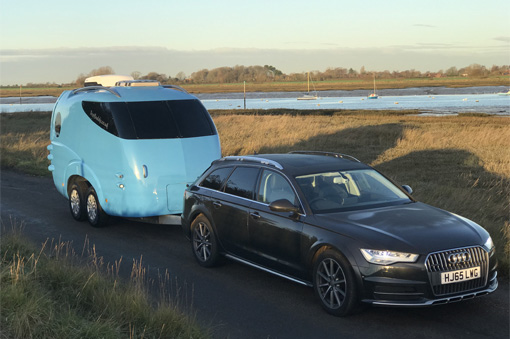
Owning a Tripbuddy will open up your world. Whether you explore new places or simply visit family favourites, Tripbuddy will ensure you arrive in style.
